|
|
| Line 38: |
Line 38: |
| | Depending on what exactly you need to do, this can be done in a few ways: | | Depending on what exactly you need to do, this can be done in a few ways: |
| | | | |
| − | 1) If you need to work on the forks, you will have to prop the engine. Of course, you will have to remove the lower fairing for that to work. Be sure to put the bike on the centerstand to reduce the weight on the exhaust headers and make the bike stable enough so it won't fall over. Examples: | + | '''1)''' If you need to work on the forks, you will have to prop the engine. Of course, you will have to remove the lower fairing for that to work. Be sure to put the bike on the centerstand to reduce the weight on the exhaust headers and make the bike stable enough so it won't fall over. Examples: |
| | | | |
| | [[Image:FrontEndSupport1.jpg | 200px]] | | [[Image:FrontEndSupport1.jpg | 200px]] |
| Line 48: |
Line 48: |
| | You can also prop the engine with a jack or jackstand (which goes under the oil drain bolt). <b>This method is less stable</b>, but allows you to raise or lower the front end smoothly, and with some jacks there is no need to remove the lower fairing. | | You can also prop the engine with a jack or jackstand (which goes under the oil drain bolt). <b>This method is less stable</b>, but allows you to raise or lower the front end smoothly, and with some jacks there is no need to remove the lower fairing. |
| | | | |
| − | 2) Of course, there is a civilized way of supporting the front: Use a front stand. But be careful when you do so. You '''have to''' either use a centerstand that is tall enough to keep the rear wheel off the ground or a rear/swingarm stand along with the front stand. Having the rear wheel on the ground and the front on a stand is just one small step more stable than the bike standing by itself on its own 2 wheels. | + | '''2)''' Of course, there is a civilized way of supporting the front: Use a front stand. But be careful when you do so. You '''have to''' either use a centerstand that is tall enough to keep the rear wheel off the ground or a rear/swingarm stand along with the front stand. Having the rear wheel on the ground and the front on a stand is just one small step more stable than the bike standing by itself on its own 2 wheels. |
| | | | |
| | You should really only use the centerstand/front stand combination for short-term projects (less than one day). Longer than that and the rear stand adds noticeably more stability to the whole setup. | | You should really only use the centerstand/front stand combination for short-term projects (less than one day). Longer than that and the rear stand adds noticeably more stability to the whole setup. |
| Line 57: |
Line 57: |
| | [[image:100_1393.jpg|150px]] | | [[image:100_1393.jpg|150px]] |
| | | | |
| − | 3) If you have access to an overhead beam, a ratcheting tie-down (with a large ratchet mechanism) can be strung between the top triple clamp and the beam. Run your strap under one side of the triple, around the rear of the steering stem, then under the triple on the other side and back up to the rafter. Make sure it pulls evenly on both sides of the triple.
| + | '''3a)''' If you have access to an overhead beam, a ratcheting tie-down (with a large ratchet mechanism) can be strung between the top triple clamp and the beam (or two beams - see picture below). Run your strap under one side of the triple, around the rear of the steering stem, then under the triple on the other side and back up to the rafter. Make sure it pulls evenly on both sides of the triple. |
| | | | |
| | [[image:yeild.jpg|150px]] | | [[image:yeild.jpg|150px]] |
| Line 63: |
Line 63: |
| | If you use this method, be careful not to put pressure on any cables or wires, and ensure that the tie-down is pulling on the center of the bike. This is not the best way to do it, but can be useful when supporting under the bike isn't an option. | | If you use this method, be careful not to put pressure on any cables or wires, and ensure that the tie-down is pulling on the center of the bike. This is not the best way to do it, but can be useful when supporting under the bike isn't an option. |
| | | | |
| − | 4) If you just need to take the front wheel off, you can: | + | '''3b)'''A better way to do this is to loop the tie-down through the frame. There are two reasons for this. 1. It's impossible to do it around the top triple without removing a bolt holding the ignition wires in place. 2. You can't remove the triples when you're holding the bike up by them. |
| | + | |
| | + | You don't need to disassemble anything for this option; it doesn't pinch or touch anything important, and it's fast. It's as stable as it gets when suspending a bike like this and on the center stand (meaning the front end swings a bit). Make sure you loosen any bolts while the front end is still on the ground. If your bike doesn't have a centerstand, you have to also use a rear stand. |
| | + | |
| | + | [image:IMG_2358.JPG|150px]] |
| | + | [image:IMG_2354-2.JPG|150px]] |
| | + | |
| | + | '''4)''' If you just need to take the front wheel off, you can: |
| | | | |
| | * put the bike on the centerstand | | * put the bike on the centerstand |
| | * loosen the axle nut | | * loosen the axle nut |
| − | * ask your friend to sit on the back of the bike, thus raising the front a little bit... | + | * ask your friend to sit on the back of the bike, thus raising the front a little bit |
| | * take the wheel off and prop the forks on a cinder block with a piece of wood on top of it. Another option is to put the axle back in and support the front with the axle on a jackstand. | | * take the wheel off and prop the forks on a cinder block with a piece of wood on top of it. Another option is to put the axle back in and support the front with the axle on a jackstand. |
| | | | |
| − | The obvious downside is that this is not very stable. <b>Taking off both wheels</b> with the front end supported in such a way is <b>not recommended</b>. However, you don't need to take off any fairings for this method to work. | + | The obvious downside is that this is not very stable. <b>Taking off both wheels</b> with the front end supported in such a way is <b>not recommended</b>. |
| | | | |
| | == Working on the Engine == | | == Working on the Engine == |
Revision as of 23:33, 22 September 2010
Though covered in the service manual, many people use creative methods to support a bike while servicing it. This often results in tip-over accidents. Below we list methods that are proven to work, as well as general tips for preparing your bike for service.
Disconnecting the Battery
If there is a chance you will work on electrical components, it is a good idea to disconnect the battery. Remember that some wires are hot even when the key is in the OFF position.
To disconnect the battery:
- Remove the seat.
- Unscrew the bolt on the Negative (-) terminal of the battery. Push the wire aside, then screw the bolt back in (this way it won't get lost).
- Put a piece of duct/scotch tape on the terminal.
Supporting the Rear End
Luckily, the Ninja 250 has a centerstand, so it can be used to support the rear end.
A few comments about using the centerstand:
- Some services require pushing the rear tire forward. This can easily result in collapsing of the centerstand and subsequent tip-over. Always block the front tire from moving with a brick or something similar to prevent such accidents. Using a tether to tie the front wheel to the centerstand works well, too.
- If you need to raise the rear end more than the centerstand does, put a board in front of the rear tire before putting the bike on the centerstand. This will wind up under your centerstand when you put it down, effectively making the centerstand longer. In this case blocking the front tire well is vital, since the nose of the bike is pointing down and it's very easy to rock the bike off the centerstand.
- Unfortunately, a bike on the centerstand is not stable enough side-to-side. If you are doing something that requires brute force (such as removing the axle nut) be very careful, as you can literally twist the bike into the ground. Having another person holding the bike is very useful in this situation.
- Finally, the centerstand is best used on a flat, sturdy surface. If you have trouble putting your bike on the centerstand, visit this link.
- Sometimes you won't be able to use the centerstand. If you can find a secure way to hold up the rear of the bike using the grab bar, go ahead. Using secondary support with jackstands and a jack under the engine is still highly recommended. The straps on the front are for stabilizing the bike only; don't lift it by the bars.
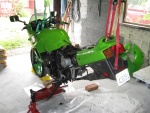
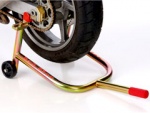
- Of course, if you are not satisfied with the centerstand, you can always buy a swingarm (rear) stand. They are quite handy for maintenance and all-around servicing. This model from Pit Bull is known to work:
Supporting the Front End
Depending on what exactly you need to do, this can be done in a few ways:
1) If you need to work on the forks, you will have to prop the engine. Of course, you will have to remove the lower fairing for that to work. Be sure to put the bike on the centerstand to reduce the weight on the exhaust headers and make the bike stable enough so it won't fall over. Examples:
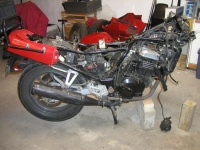
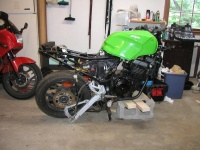
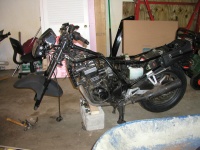
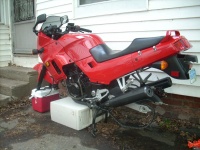
You can also prop the engine with a jack or jackstand (which goes under the oil drain bolt). This method is less stable, but allows you to raise or lower the front end smoothly, and with some jacks there is no need to remove the lower fairing.
2) Of course, there is a civilized way of supporting the front: Use a front stand. But be careful when you do so. You have to either use a centerstand that is tall enough to keep the rear wheel off the ground or a rear/swingarm stand along with the front stand. Having the rear wheel on the ground and the front on a stand is just one small step more stable than the bike standing by itself on its own 2 wheels.
You should really only use the centerstand/front stand combination for short-term projects (less than one day). Longer than that and the rear stand adds noticeably more stability to the whole setup.
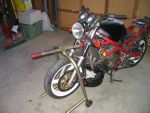
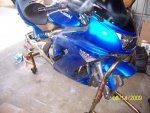
If you're buying a stand, the kind that supports the bike under the triple tree is more useful than the kind that goes under the forks:
3a) If you have access to an overhead beam, a ratcheting tie-down (with a large ratchet mechanism) can be strung between the top triple clamp and the beam (or two beams - see picture below). Run your strap under one side of the triple, around the rear of the steering stem, then under the triple on the other side and back up to the rafter. Make sure it pulls evenly on both sides of the triple.
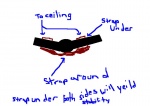
If you use this method, be careful not to put pressure on any cables or wires, and ensure that the tie-down is pulling on the center of the bike. This is not the best way to do it, but can be useful when supporting under the bike isn't an option.
3b)A better way to do this is to loop the tie-down through the frame. There are two reasons for this. 1. It's impossible to do it around the top triple without removing a bolt holding the ignition wires in place. 2. You can't remove the triples when you're holding the bike up by them.
You don't need to disassemble anything for this option; it doesn't pinch or touch anything important, and it's fast. It's as stable as it gets when suspending a bike like this and on the center stand (meaning the front end swings a bit). Make sure you loosen any bolts while the front end is still on the ground. If your bike doesn't have a centerstand, you have to also use a rear stand.
[image:IMG_2358.JPG|150px]]
[image:IMG_2354-2.JPG|150px]]
4) If you just need to take the front wheel off, you can:
- put the bike on the centerstand
- loosen the axle nut
- ask your friend to sit on the back of the bike, thus raising the front a little bit
- take the wheel off and prop the forks on a cinder block with a piece of wood on top of it. Another option is to put the axle back in and support the front with the axle on a jackstand.
The obvious downside is that this is not very stable. Taking off both wheels with the front end supported in such a way is not recommended.
Working on the Engine
If you plan to work on the engine, you should get an engine stand.
Common Mistakes
- Forgetting to disconnect the battery, or not doing it right and frying something. Remember: red cap goes on the '+' terminal.
- Rocking the bike off the centerstand by accident when the front wheel was not blocked.
- Flipping the bike sideways while using a wrench/breaker bar.
Make sure you can stabilize the bike somehow while applying brute force. For example, you can sit backwards on the bike while tackling the rear axle nut. Another example is to start loosening the oil drain bolt on the sidestand and then switch to the centerstand.
- Some services require draining the oil. Don't forget to fill it back up after you are done! It does happen sometimes and makes people go crazy.


