|
|
| Line 9: |
Line 9: |
| | ==Wind noise== | | ==Wind noise== |
| | | | |
| − | One of the main reasons people try a different screen is to mitigate the noise of the wind coming across the screen. Here is where the noise comes from listed from quietest to most noisy: | + | One of the main reasons people try a different screen is to mitigate the noise of the wind coming across the screen. Here is where the noise comes from, listed from quietest to most noisy: |
| | | | |
| | 1 '''Fairing-protected air:''' Fairing-protected air is the most quiet, but it is difficult to keep completely in the quiet bubble of still air (especially your head/helmet) without crouching low or going very tall on the windscreen. | | 1 '''Fairing-protected air:''' Fairing-protected air is the most quiet, but it is difficult to keep completely in the quiet bubble of still air (especially your head/helmet) without crouching low or going very tall on the windscreen. |
| | | | |
| − | 2- Clean air not stirred up by the fairing: | + | 2 '''Clean air not stirred up by the fairing:''' Clean air is not nearly as quiet, but is easy to achieve. For many riders, sit up straight or remove the windscreen and woot, there it is. |
| − | Clean air is not nearly as quiet, but easy to achieve. For many riders, sit up straight or remove the windscreen, and Voila! | + | |
| | | | |
| − | 3- Dirty air: | + | 3 '''Dirty air:''' Dirty air is the worst and can cause severe buffeting. Dirty air hitting the helmet is a significant source of deafening wind roar. This is often an unintentional by-product of raising the windscreen to the point where dirty air displaces clean air at helmet level. |
| − | Dirty air is the worst and can cause pounding buffeting. Dirty air hitting the helmet is a significant source of deafening wind roar. Unintentional byproduct of raising the windscreen to the point where dirty air displaces clean air at helmet level, that had been unaffected by the fairing. | + | |
| | | | |
| − | Scale on the pic is not intended to be 100% accurate, but just give a general idea. Different bikes have varying wind flow characteristics, different height riders sit in different positions relative to the airflow, YMMV, yadda, yadda. | + | Scale on this picture is not intended to be 100% accurate, but it gives a general idea. Different bikes have varying wind flow characteristics, different height riders sit in different positions relative to the airflow, YMMV, yadda yadda, blah blah blah. |
| | + | |
| | + | [[image:air flow.jpg|250px]] |
Revision as of 14:11, 5 November 2009
Wind noise
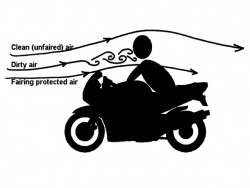
One of the main reasons people try a different screen is to mitigate the noise of the wind coming across the screen. Here is where the noise comes from, listed from quietest to most noisy:
1 Fairing-protected air: Fairing-protected air is the most quiet, but it is difficult to keep completely in the quiet bubble of still air (especially your head/helmet) without crouching low or going very tall on the windscreen.
2 Clean air not stirred up by the fairing: Clean air is not nearly as quiet, but is easy to achieve. For many riders, sit up straight or remove the windscreen and woot, there it is.
3 Dirty air: Dirty air is the worst and can cause severe buffeting. Dirty air hitting the helmet is a significant source of deafening wind roar. This is often an unintentional by-product of raising the windscreen to the point where dirty air displaces clean air at helmet level.
Scale on this picture is not intended to be 100% accurate, but it gives a general idea. Different bikes have varying wind flow characteristics, different height riders sit in different positions relative to the airflow, YMMV, yadda yadda, blah blah blah.